I’m experimenting with the idea of “.5” Episodes (8.5, 10.5 etc…). A “.5” episode will be lighter and primarily concerned with what’s happening around the studio. These episodes will be much shorter and more VLOG style. It’s an experiment to try to tune the channel. Episode 10.5 is now live, it’s concerned with the Leelanau Peninsula, mowing the lawn and snow.
Other Episodes You Might Enjoy
CrossFit, Community, Cars, Gender, Compassion and Design Education | Kelsey Elder | Episode 112
A conversation with design educator Kelsey Elder.
Kelsey Elder is an educator, typographer, and artist whose practice investigates letterforms as sites of significance, and whose research argues for these sites as culturally important epicenters for queerness, subversion, and dissent. Hailing from the the true North (Detroit by way of Minneapolis), he grew up grazing cold knuckles while wrenching away in the garage on cars and motorcycles. He is an avid petrol head, owner of a small lifestyle company and custom car garage called Lowered Values.
He is currently an Assistant Professor of Graphic Design at RISD, and has priorly taught at Purchase College of the State University of New York, Virginia Commonwealth University, and the Cranbrook Summer Art Institute. His research has been presented and published through various venues including at TypeCon 2019, the Geffen Contemporary, The New School, Mercedes-Benz, Boston University, and the University of Texas. Elder’s studio work has most recently been commissioned by–and shown at–PLUG Projects, Reverb Gallery, Cranbrook Art Museum, and the Forum Gallery.
He received his BFA in Graphic Design from the Minneapolis College of Art and Design, his MFA in 2d-Design from Cranbrook Academy of Art, and is a graduate of the Typeface Design Intensive at the University of Reading.
30 Second Videos of Work in Process by Elliott Earls
I’m using twitter as a way to post 30 second versions of my new YouTube show Studio Process. These 30 second video focus on showing work in process in the studio. Below are a few examples. Follow me on twitter to stay up to date. Tweets by @elliottearls Extended Episodes of “Studio Practice” Are a No Bull$hit […]
Analogical Reasoning in Art and Design 101 – How to Skin a Cat | Episode 64
Analogical Thinking – the process of exploring the similarities between two dis-similar objects lies at the heart of sophisticated artistic practice. Kids (and not so young “kids”) in Art and Design College are plagued by simplistic thinking and by laziness. Here’s a look at one specific strategy to invest any art object with more power. […]
Destroy Habit, Synthesize Knowledge and Take Action | Episode 9 of Studio Practice
In this episode of Studio Practice Elliott Earls provides a plan of action to destroy bad habits, synthesize new knowledge and take action in the studio. Special thanks ❤️ is in order to my frequent collaborator Joshua Ray Stephens who appears as Les Griffin along with the amazing Ries Straver (riesstraver on Instagram) in the brief […]
Mindy Seu | The Cyber Feminisist Index, Slow Tech, Programming & Artist as Networker | Episode 113
Mindy Seu (born 1991) is an American designer and researcher whose work focuses on public engagement with digital archives.Seu is currently on the Faculty at Rutgers Mason Gross School of the Arts and also teaches at the Yale School of Art.
How to Get Paid in Art & Design | Episode 12 of Studio Practice
How to Get Paid in Art & Design | Episode 12 The idea of the starving artist is so thoroughly embedded in our cultural imagination that it is nearly impossible to understand the role of the artist without poverty. In this episode we look at the idea of the artist as an economically self-sufficient cultural […]
Escape the Cube Farm | Episode 6 of Studio Practice
In this episode Elliott Earls gives suggestions for how to avoid working in the “cube farm.” He draws on the work of Detroit based designer Chris Schanck, Detroit born motivational speaker Dr. Eric Thomas and clothing designer Marc Ecko as examples. Elliott also gives away a signed, limited-edition print as a thank you to the […]
The Drawing Center, Attitudes Toward Critique & Isolations | Episode 7 of Studio Practice
Episode 7 of “Studio Practice.” In this episode Elliott Earls offers suggestions on how to learn from the critique process, shows an example of integrating family into a studio practice, discusses the benefits of failure. This episode features break dancing (isolations) and Elliott’s talk at The Drawing Center in New York. Episode Notes: David Bohm […]
Episode 65 | Art And Design College Analogical Thinking 101 – Part 2 | Chris Pinter
Analogical Thinking – the process of exploring the similarities between two dis-similar objects lies at the heart of sophisticated artistic practice. Kids (and not so young “kids”) in Art and Design College are plagued by simplistic thinking and by laziness. Here’s a look at one specific strategy to invest any art object with more power. […]
A Conversation With Cleon Peterson | Episode 106 #cleonpeterson
Cleon Peterson is an LA based artist whose chaotic and violent paintings show clashing figures symbolizing a struggle between power and submission in the fluctuating architecture of contemporary society. #cleonpeterson
Academic Anarchy: Understanding the Chaos and Crisis Inside Colleges and Universities Elliott Earls
Academic Anarchy: Understanding the Chaos and Crisis Inside Colleges and Universities Elliott Earls
Comment Response Video for “Art Crit is Broken” Video Posted
🍀🍀🍀🍀 In this video Elliott Earls answers questions from viewers of Episode 23 “Art Critique is Broken. Fix it!” 🍀🍀🍀🍀
Artificial Intelligence Art School Meltdown | The Looming Crisis | Episode 128 | Elliott Earls
As the use of AI in art grows, there is a lot of excitement and fear among artists, educators, and art enthusiasts. AI-generated art has been making headlines in recent years with prominent artists using AI tools to create mind-bending pieces. But with AI-generated art now infiltrating the admissions process in art schools, there are growing concerns about its impact on the future of the industry.
Designing & Screen Printing a Limited Edition Print | Episode 16
“Cycloptical Power In A Culture Ruled By Narcissism (Oblique)” is a 22 x 30 inch, three color hand pulled screenprint. Elliott Earls walks the viewer through the design and production process. The print was produced in an edition of ten.
An Approach to Graphic Design That Doesn’t Stink | Episode 110
An Approach to Graphic Design That Doesn’t Stink | Episode 110
The Death and Resurrection of 1990’s Experimental Graphic Design | Part 2 | Episode 58
In Part 2 of “The Death and Resurrection of 1990’s Experimental Graphic Design” we take a look at the movment and what it will take to resurrect it.
Why Twitter Is A Dumpster Fire of Design Criticism | Episode 104
Clout chasing and trolling and linguistic killshots are major elements of the dumpster fire that is “design criticism” on Twitter. In this episode, we take a look at how the structure of Twitter rewards these behaviors under the auspices of legitimate criticism.
Here is the link to Wes Larsen’s critique of the work of John Gelardi:
https://www.minislimited.com/product/wes-larsen-critique-of-the-work-of-john-gelardi-free-download
#designtwitter #design #designcriticism #graphicdesign
How to Make a Formalist Avant-Garde Design/Art Object | Episode 21
What are the mechanics of making a formalist avant-garde design/art object? How is a the formailist avant-garde different than the historical avant-garde? how can you make more compelling art/design objects?
Wrongthink Part 2. The Outsider | Episode 55
Wrongthink Part 2: Linguistic intelligence and verbal acuity (one’s ability to talk all proper ’n what not), seem to be critical components of an effective studio practice. It’s hard to make a case against verbal communication skills. However, when we bracket off what’s said from the work itself, what are we left with? At times […]
How is Studio Practice Like Scientology? | Episode 8
Episode 8 of Studio Practice deals with the issues of which we must not speak. Friedrich Nietzsche, Scientology, Aesop Rock and Reviews at Cranbrook Academy of Art are topics of discussion. Don’t be afraid to post to the comment section. Notes on the episode: Thus Spake Zarathustra http://www.amazon.com/Spake-Zarathustra-Dover-Thrift-Editions/dp/0486406636 Subscribe to the Studio Practice Channel When […]
Episode 21.5 Comment/Response Posted
This comment/response video relates to Episode 21 of Studio Practice.
Good Weather. Suburban Context Aggressively Contemporary Art | Episode 26
Good Weather is an artist run contemporary art space in North Little Rock, Arkansas. The Founder and Curator is Haynes Riley. In this episode as Elliott Earls prepares for his exhibit at Good Weather, we take a close look at this unique space. We examine how family, suburbia and southern living contribute to a truly […]
The Breakfast Club + The NFL VS Contemporary Art | Episode 42
Powerful lessons for the artist from the Breakfast Club and the NFL. Links, Institutions and References from this Episode Powerful lessons for the artist from the Breakfast Club and the NFL. Links, Institutions and References from this Episode ############################################# Regarding The Films of John Hughes Information on the filmmaker John Hughes from IMDB. John Hughes […]
3/30 How The Criticism Feedback Loop Destroys the Solipsism Vacuum | Episode 92
Many young artists express allegiance to a kind of solipsistic ethos through blind devotion to the purity of their “art.” This naive approach to work is very dangerous to a sustained artistic life. In this episode we take a look at one possible solution to the problem.
Henry Earls | A Savage Ride Through the Collaborative Creative Process | Family Matters | Part 3
ChatGPT Wrote This: At the heart of it all was a 20-year-old artist living in the Bowery in Manhattan. This young man was a true original, a rebel who defied convention and pushed boundaries with his work. He was a force to be reckoned with, a bright star burning with creative energy.
A 5 Point Investment Plan To Transform Your Creative Practice | Investing for Creative Freedom
A 5 Point Investment Plan To Transform Your Creative Practice | Investing for Creative Freedom
Blooper & Outtake Reel Saranay Motel | Episode #32
Who doesn’t love Bloopers? The Saranay Motel is/was Elliott Earls quixotic and ill-fated feature length digital film. Episode 32 of Studio Practice is a quick “blooper” reel from the film.
Dank Meme Edition | Episode 20 of Studio Practice
Celebrate the release of Episode 20 with this special Dank Meme Edition. In this episode Elliott Earls under takes an exploration of the cultural importance of the dank meme.
Harris Earls | Family Matters Part 2 | Episode 123
Harris Earls is collaborating with Henry and Elliott Earls for a show at Wasserman Projects. The show opens on March 18th 2023. This episode takes a look at Harris Earls in the studio.
Episode 30.5 Comment Response To Episode 30
Thoughts from viewers of Episode 30 addressed here.
Artificial Intelligence Uncanny Painting Collapse | CHANGE | Episode 130 | Elliott Earls
Artificial Intelligence (AI) has been making tremendous strides in recent years, and the field of image creation is no exception. AI image creation tools, such as deep learning neural networks, are now capable of generating highly realistic images that can be mistaken for photographs. However, as these tools continue to advance, they are also having an unexpected impact on the world of contemporary representational painting. In this video, we will explore how AI is forcing a crisis in contemporary representational painting and how painters must adapt to this new reality.
Micro-Compositions in Experimental Graphic Design | Part 3. Quick Take | Episode 60
This is Part 3 of “The Death and Resurrection of 1990’s Experimental Graphic Design.” In this episode we examine the role that micro-compositions can play in solving a tricky langauge problem.
Episode 106 | A Conversation With Wesley Taylor
Wes Taylor is an emcee and graphic designer in the rap group, Athletic Mic League. He’s co-founder of Emergence Media and co-founder of Talking Dolls Studio. He’s a lead artist in the Complex Movements collective. Wesley holds a graduate degree in 2-D design from Cranbrook Academy of Art. #complexmovements #athleticmicleague
Electronic Music Synth As A Critique Tool in Contemporary Art | Episode 30
Can understanding how synthesizers like the Minimoog and Nordlead shape sound help distinguish between “good” and “bad” in contemporary art? The “Earls ADSR Synthesis Model For The Evaluation of Works of Visual Art” is a tool to help the studio artist critically assess works of visual art. Issues of value and quality are notoriously problematic […]
MASTERCOPY: Why Artschools Get Everything So Wrong | Episode 114
Repertoire and the “mastercopy” are two very different ideas in art. In this episode we take a look at how “repertoire” functions in music and theater training and how the “mastercopy” functions in visual art. This leads to a discussion with Joshua Ray Stephens and Matthew Walsh on the limitations of art school.
Ed Fella Anti-Master | Episode 29
The American Graphic Designer and Artist Ed Fella embodies the principle of anti-mastery. In this episode, we take a look at Fella’s work and his role in the Cranbrook Design biome.
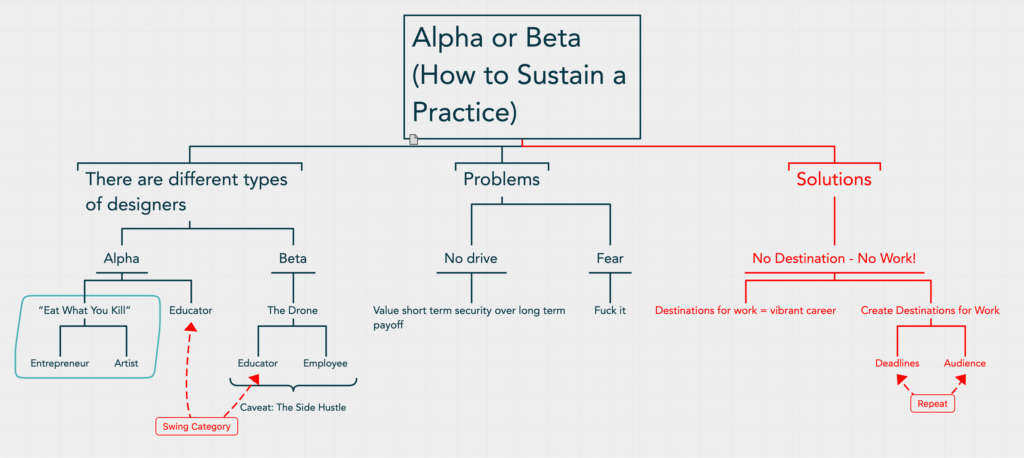
PDF Précis for Episode #117
This is the Prédis from Episode 117 of Studio Practice “Alpha Designer. Beta Designer.” Click to download a PDF.
Against the Global Influence of Dutch Graphic Design | Episode 17 of Studio Practice
In this episode the British teddy-boys, mods, skinheads and punks serve as a point of departure for Elliott Earls to make a case against the global influence of Dutch graphic design. Elliott draws on the work of Dick Hebdidge and his theory of subculture development to suggest another method for moving your work to a […]
Digital Sin or Salvation? Aquinas Tackles Doomscrolling, Cancel Culture & Tragic Memes
### What’s Inside? 🎬
1️⃣ **Human Nature and Vice**: Is doomscrolling a disordered form of the otherwise virtuous desire for knowledge? We explore this through the lens of Thomistic ‘curiositas.’ (#Curiositas)
2️⃣ **The Common Good**: Could doomscrolling and memeification of tragedy be undermining our community bonds and societal structures? Aquinas would have something to say about it! (#CommonGood)
3️⃣ **Prudence and Time Management**: Are we squandering precious time engaging in these behaviors? Let’s break down what Aquinas might think in terms of prudence. (#Prudence)
4️⃣ **Effects on Mental Health**: How does this constant scrolling affect our emotional and spiritual well-being? (#MentalHealth)
5️⃣ **Dignity of Human Life**: What happens when we turn tragic events into memes? How does it affect our ethical considerations? (#HumanDignity)
6️⃣ **Truth and Representation**: Are memes distorting the truth, pulling us away from the intellectual goals that philosophers like Aquinas held dear? (#TruthMatters)
7️⃣ **Community and Solidarity**: Could meme culture be dissolving our sense of community and mutual responsibility? (#CommunityMatters)
8️⃣ **Moral Theology**: How do these behaviors affect our moral integrity? Aquinas’ views on scandal could be enlightening. (#MoralTheology)
“Studio Practice” Episode #4 Looks at Super Anti-Zero 12
The Studio Practice YouTube show and channel continues to take shape. Episode 4 is slightly longer form, clocking in at three minutes and thirty eight seconds. In this episode Elliott Earls discusses the manufacture of Super Anti-Zero 12 (Chromed), tours his machine shop and plays a hockshop version of the Hobbit Theme on the tin whistle. Twitter […]
September 2016 Extreme Dank Meme Compilation | Episode 23.5
The most exteme dank memes.
Wrongthink, Safespaces, Thought Crimes and Art | Episode 54 of Studio Practice (Part 1)
Episode 54 of Studio Practice is about “Wrongthink” and “Thoughtcrime.” I find it staggeringly hard to believe that in the dumpster fire that is our national conversation regarding; free speech, safe spaces and the nature of higher education, Art & Design are “bit players.” Why is it that Journalism and the Humanities (NOT Art!) are […]
The Grind Paradox | How to Kill Your Work | Episode 81
Dedication to the grind in the artist studio is a fundamental component of a successful studio practice. The lazy shall not inhert the earth. There is a fundamental natural law.: You reap what you sow. What’s the right approach to criticisim WHILE ACTUALLY IN THE PROCESS OF MAKING? Hint, fluid production is key.
“.5” Episodes Are Lighter And About Life | Episode 10.5 of Studio Practice
I’m experimenting with the idea of “.5” Episodes (8.5, 10.5 etc…). A “.5” episode will be lighter and primarily concerned with what’s happening around the studio. These episodes will be much shorter and more VLOG style. It’s an experiment to try to tune the channel. Episode 10.5 is now live, it’s concerned with the Leelanau Peninsula, […]